
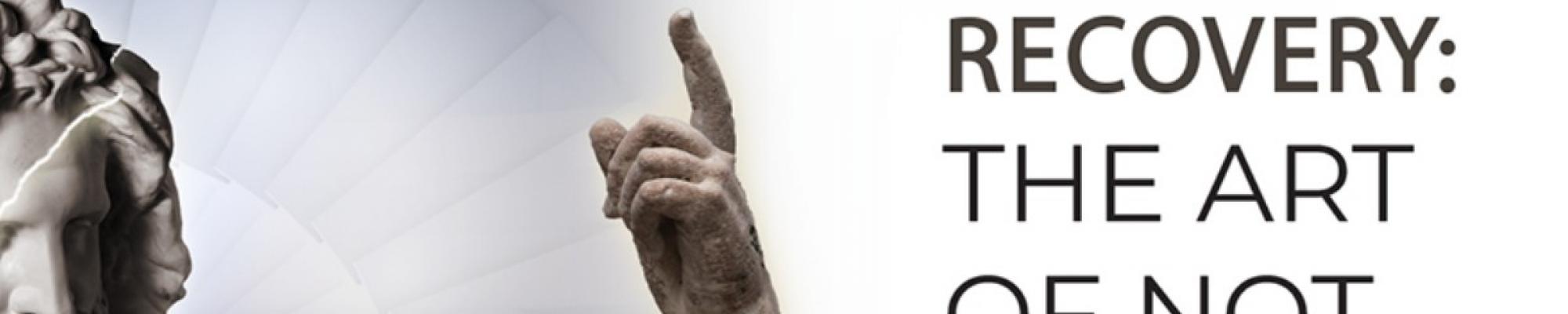
Recovery: The Art of Not Playing God
By Rabbi Rami Shapiro
Hi. My name is Rami. I am a recovering food addict.
My true addiction, however, as Bill W. writes in the “Big Book” of Alcoholics Anonymous, is playing God. In my experience, playing God means bending reality to my will, ignoring the karmic law of cause and effect, and creating the life I want through sheer force of personality, aided by conscious intentions, affirmations, and visualizations.
When that fails, which it does 100 percent of the time, I blame my failure on others who, also addicted to playing God, resist my attempts to bend reality to my will by trying to bend it to their own. They oppose my creating the life I want through my conscious intentions, affirmations, and visualizations by creating the life they want through their own conscious intentions, affirmations, and visualizations.
Exhausted from this endless and futile battle of opposing wills, I eat compulsively. The core of my recovery isn’t about stopping compulsive eating but about letting go of playing God. To that end, I’ve been working the 12 steps as a practice for 20 years. Here’s some of what I’ve learned about them along the way.
STEP ONE:
We admitted we were powerless over our addiction—that our lives had become unmanageable.
While those who follow the 12 steps to achieve sobriety focus on the first part of step one, the second part reveals a deeper truth: Whether we are an addict or not, life is unmanageable. Life is tohu va-vohu: wild and chaotic (Genesis 1:1), and each moment is havel havalim: as fleeting as breath (Ecclesiastes 1:2). Playing God—trying to control the chaotic and impermanent—is the insanity that drives our addictive behavior. Admitting that life is unmanageable frees us from this insanity. But then what?
STEP TWO:
We came to believe that a Power greater than ourselves would restore us to sanity.
Once I stopped playing God, I understood what the Hindus call lila, the play of God manifesting all life, just as the ocean’s play manifests all waves. While 12-step groups often talk about a Higher Power, the steps refer to a Greater Power. The difference matters. A Higher Power is above us; a Greater Power embraces us. Recognizing myself as part of, and never separate from, this Greater Power is essential for my sanity.
STEP THREE:
We made a decision to turn our will and our lives over to the care of God as we understood God.
Step three seems like a deliberate decision, but it isn’t. It occurs as a result of steps one and two: I didn’t make a decision; a decision was made. When I stopped playing God and realized the Greater Power “in whom I live and move and have my being” (Acts 17:28), my life and my will were effortlessly surrendered to God.
Living under God’s care is what the Chinese call wei wu wei, living without forcing things. In English, we say it as “cutting with the grain,” “tacking with the wind,” and “swimming with the current.” It is the opposite of playing God by forcing my will against God’s; it is working with God’s will to promote compassion, justice, peace, and love in every situation I face.
STEPS FOUR & FIVE
We made a searching and fearless moral inventory of ourselves.
We admitted to God, to ourselves, and to another human being the exact nature of our wrongs.
Free from the distorted reality caused by playing God, we can now conduct a “searching and fearless moral inventory” of our wrongs and clearly see the damage we cause by playing God. This isn’t an act of self-flagellation but an honest appraisal of what life is like when we live as if we were God.
Admitting these things to myself wasn’t too difficult. However, sharing it with my sponsor was more revealing because he was wise enough not only to listen to my “confession,” but also to ask how I had justified my failings to myself and my behavior to others. As I described the “crazy thinking” I used to deny the crazy behavior I had engaged in, I couldn’t help but laugh at the absurdity of how I had been living. The laughter felt cleansing.
STEPS SIX & SEVEN
We were entirely ready to have God remove all these defects of character.
We humbly asked God to remove our shortcomings.
“Be holy, because I, YHVH, am holy” (Leviticus 19:2). “Be perfect, therefore, as your heavenly Father is perfect” (Matthew 5:48). These commands make sense only if we and God share a common essence. Think of the earlier analogy of God as the ocean and you and me as the waves of the ocean. The ocean cannot say to us waves, “Be an ocean because I am an ocean.” That would demand the impossible of us. But, figuratively speaking, the ocean could say, “Be water as I am water,” for the ocean and its waves share that fundamental unity. The same is true of us and God.
When we understand this, which we learned in step two, our defects and shortcomings, although not erased, are so weakened in the face of the Greater Power that they become ineffective.
STEPS EIGHT, NINE, & TEN:
We made a list of all persons we had harmed and became willing to make amends to them all.
We made direct amends to such people wherever possible, except when to do so would injure them or others.
We continued to take personal inventory and when we were wrong promptly admitted it.
My practice of step eight is inspired by the Japanese introspective tradition called Naikan (inner seeing), which I wrote about in the previous issue of this magazine. Instead of concentrating on the harm I caused others, I reflect on the kindness I received from them by asking myself three questions each night: What kindnesses did I receive today? What kindnesses did I offer today? What suffering did I cause today?
By focusing on both the kindnesses I’ve received and the harm I’ve caused, I can work both to lessen the suffering I caused and to pay forward the kindnesses I have received—aiming to reduce suffering overall. In this way, I practice steps nine and ten.
STEP ELEVEN:
We sought through prayer and meditation to improve our conscious contact with God as we understood God, praying only for knowledge of God’s will for us and the power to carry that out.
My prayer practice focuses on what is called hagah in Hebrew and mantra-japa in Sanskrit: the recitation of a sacred phrase you repeat throughout the day. One I often recommend comes from Psalm 16:8. In Hebrew it is Shiviti YHVH l’negdi tamid, “I keep the Divine before me always.”
I was taught to recite this while brushing my teeth, walking my dog, waiting in line, waiting on hold on the phone, and so on as a way to center myself in the Divine and stay aware of the Divine manifesting in all of reality.
My main meditation practice involves simply listening to what is known in Hebrew as kol d’mamah daka, the pure sound of silence (1 Kings 19:10). In Sanskrit, this sound is called nada, an eternal white noise that fills the universe. As Ajahn Sumedo writes in his book, The Sound of Silence:
[The sound] is a cosmic hum, a scintillating, almost electric background noise. Although it’s always present, we generally don’t notice it … [But it] is not something you need to seek; instead, you simply open yourself to it: it’s the ability to listen with your mind in a receptive state that lets you hear the sound of silence … By listening to the sound of silence, you can start to contemplate non-thinking because when you are solely focused on the cosmic sound, there are no thoughts … When you’re just with the cosmic sound, there is pure attention, with no sense of a person or personality, of me and mine.
Mantra and meditation constantly clear our perception and remove the illusion of separation that fuels all our addictions, including the primal addiction of playing God.
STEP TWELVE:
Having had a spiritual awakening as the result of these steps, we tried to carry this message to addicts and to practice these principles in all our affairs.
Spiritual awakening is the realization that God is all there is. My experience with 12-step practice confirms that such an awakening is possible. The “having had” of step twelve goes far beyond the “came to believe” of step two. But I have discovered that one more step is needed.
STEP THIRTEEN:
Go back to step one.
When people first encounter the 12 steps, they often see them as a ladder leading out of the pit of addiction. When they reach step twelve, they believe they are finished. But they are never truly finished. The steps aren’t a ladder but a spiral staircase. You move from step one to step twelve and then find yourself back at step one again—a higher, more subtle, and more nuanced step one, but still step one. There’s no limit to our capacity for delusion, no end to our playing God even as we deny doing so. So we keep working the steps. Arriving at step one repeatedly isn’t a sign of failure; it’s a sign of grace.
Playing God, our motto is, “Win by any means necessary.” Working the steps, our motto is the subtitle of the late Andrew Fluegelman’s 1976 classic, The New Games Book: “play hard, play fair, nobody hurt.”
This article appeared in the November/December 2025 issue of Spirituality & Health®: A Unity Publication. Subscribe now.
< Back to Spirituality & Health: A Unity Publication November/December 2025